A Walking Guide to the MiMo District’s Mid-Century Motels
Just south of NE 79th Street, Biscayne Boulevard turns into an open-air museum of 1950s roadside architecture: neon signs, boomerang canopies and motels built to catch a driver’s eye at 40 miles an hour. Here’s a self-guided walk through the MiMo Historic District, with the stories behind the buildings worth stopping for.
What “MiMo” means
MiMo is short for Miami Modern, a name coined by preservationists Randall Robinson and Teri D’Amico for the architecture that flourished in South Florida from 1945 into the late 1960s. According to the MiMo Biscayne Association, the flashier “Resort MiMo” strain borrowed from Hollywood set design, car styling, jet planes and the space race, which is why you see so many acute angles, boomerangs and trapezoids.
On Biscayne Boulevard the style found its perfect building type: the motel, a “motor hotel” designed for families driving down U.S. 1 in the post-war boom.
The MiMo/Biscayne Boulevard Historic District at a glance
The City of Miami designated the district on June 6, 2006. It covers Biscayne Boulevard from NE 50th Street to NE 77th Street, with a period of significance running from 1923 to 1967. The boulevard itself was begun in 1925, at the peak of Miami’s land boom, and after World War II it became the city’s premier strip for motels.
Not everything here is from the 1950s. The association points to Mediterranean Revival commercial buildings at 7120 and 7235 Biscayne Blvd and Art Deco examples at 7222 and 7240 Biscayne Blvd, all on the stretch you’ll walk first.
Start at the Vagabond and the Coppertone Girl (73rd Street)
From NE 79th Street, head south on Biscayne about six blocks to the Vagabond at 7301 Biscayne Blvd. It opened in 1953, designed by architect B. Robert Swartburg, whose other work included Miami Beach’s Delano Hotel, according to the hotel’s own history. It was designated a local historic site in 2003, bought by developer Avra Jain in 2012, reopened as a 42-room boutique hotel in August 2014 and added to the National Register of Historic Places that December.
From the sidewalk, look for the cloud-and-stars sign that still says MOTEL and Juan Stacholy’s fountain of three nymphs and dolphins in a giant pink clamshell, which has been on the corner since the beginning.
Directly across the boulevard, on the north wall of 7300 Biscayne Blvd, is the roughly 35-foot Coppertone Girl sign. The MiMo Biscayne Association says it first went up in 1959 on the Parkleigh Building downtown, was damaged by Hurricane Andrew in 1992, and was restored and reinstalled here in 2008. The association owns and cares for it.
Walk south: the Biscayne Hotel and the New Yorker
Keep heading south. At 6730 Biscayne Blvd, the Biscayne Hotel is another former motel brought back as a boutique stay, with clean mid-century lines.
A few blocks on, the New Yorker at 6500 Biscayne Blvd describes itself as a classic 1950s Miami hotel. Its angular facade and neon sign are among the most photographed on the strip, and it sits close to Legion Park, so this is a good spot to detour to the bayfront for a breather.
Finish with the sea-themed motels: the Shalimar and the Sinbad
The final stretch, around NE 61st and 62nd Streets, holds two motels from a group that played on sea adventure and exotic places. The Shalimar at 6200 Biscayne Blvd was designed by Edwin Reeder in the early 1950s and got a full renovation in 2013.
Next door to the south, the Sinbad Motel at 6150 Biscayne Blvd dates from 1953. Architect Tony Sherman shaped it like a ship, since the bay was visible from the property back then, and named it after Sinbad the Sailor. Its neon signs appear in the 1995 film Miami Rhapsody.
That’s the core of the walk: about a dozen blocks from the Vagabond to the Sinbad. If you have more energy, the district continues south to NE 50th Street.
Why the motels nearly disappeared
By the late 1960s, interstate highways were pulling drivers off U.S. 1 and cheap flights meant fewer people made the long drive to Miami. Many motels were demolished, converted or left to decline. Preservationists including Teri D’Amico, Randall Robinson, Nancy Liebman and Fran Rollason pushed for recognition, and the 2003 Vagabond designation and 2006 district designation gave the surviving buildings protection.
Today the district is a mix of restored hotels, motels still waiting for their comeback, and newer shops and restaurants in old buildings, which is part of its charm.
Tips for your walk
- Go at dusk. The neon is the whole point. Start in late afternoon and finish after dark.
- Stay on the sidewalk. Most of these are working hotels with guests. Admire and photograph from the street unless you’re a customer.
- Cross carefully. Biscayne Boulevard is a busy highway. Use the signalized crosswalks.
- Plan a food stop. The boulevard and nearby NE 79th Street have plenty of places to eat. Browse our local directory and check hours before you go.
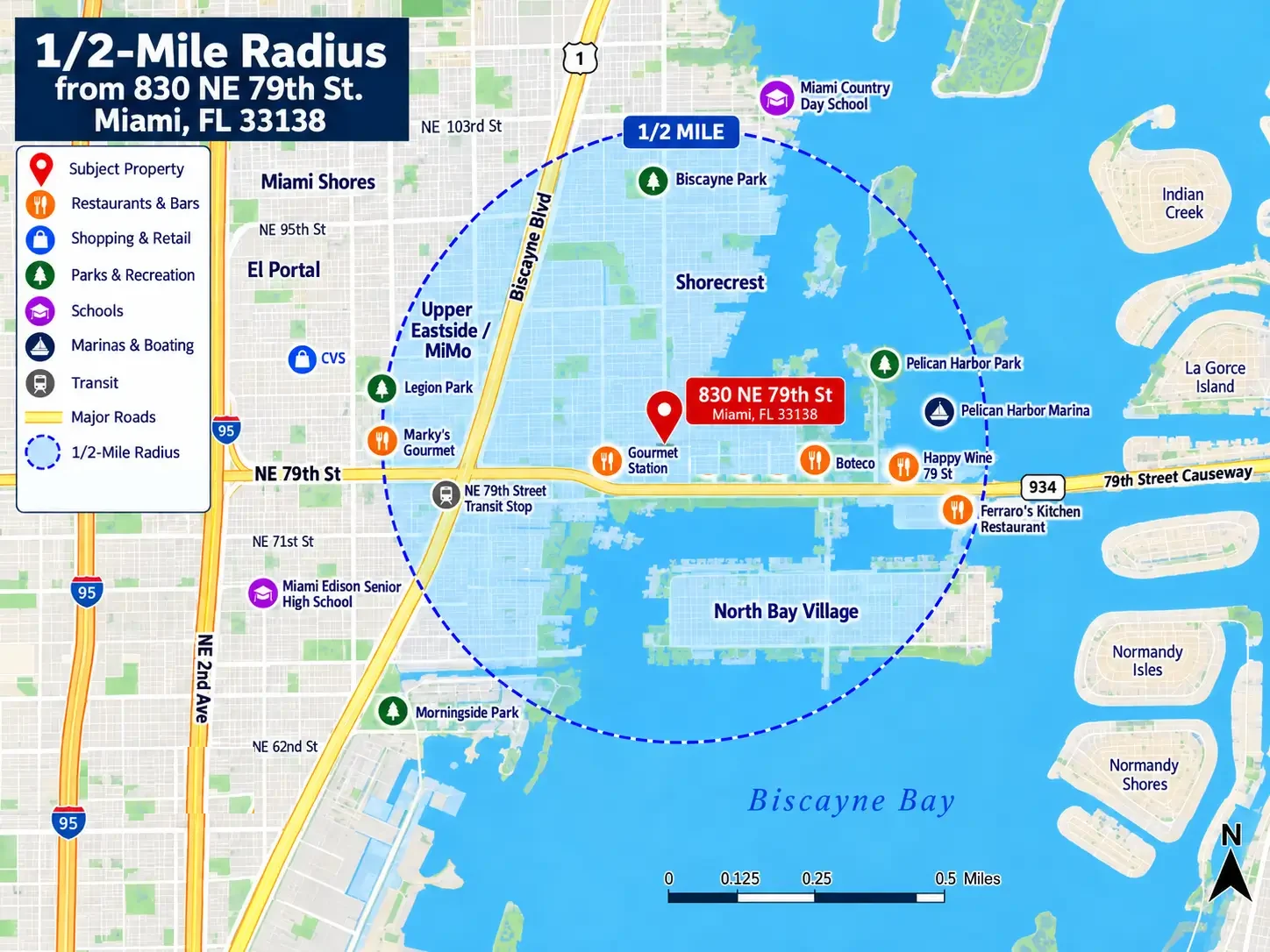
Want to fill out the day? Our guide to things to do near NE 79th Street covers the farmers market, Pelican Harbor and the beach, and our nearby page maps what’s around the corridor.
Frequently asked questions
Where is the MiMo District in Miami?
The MiMo/Biscayne Boulevard Historic District runs along Biscayne Boulevard from NE 50th Street to NE 77th Street in Miami’s Upper Eastside, just south of NE 79th Street.
When was the MiMo District designated?
The City of Miami designated the MiMo/Biscayne Boulevard Historic District on June 6, 2006.
Can I go inside the motels?
Many are operating hotels, so the lobbies and grounds are for guests and customers. Everything in this guide can be enjoyed from the public sidewalk.